Can I Just Have a Tooth Pulled Instead of a Root Canal in Hebron?
Pulling the tooth is a real option, and the better choice depends on what is left of it and what you plan to put in the space afterward.
Can you just extract a tooth instead of a root canal?
Yes, in most cases a tooth that needs a root canal can be extracted instead. It is quicker on the day. But a missing tooth changes your bite, lets nearby teeth drift and lets the jawbone shrink, so most patients end up replacing it. If the tooth can be saved, a root canal is often the better long-term value. (972) 770-2607
What does a root canal save that an extraction does not?
A root canal removes the infected or inflamed pulp inside the tooth, cleans and seals the canals, and leaves the root in the bone. That root keeps doing quiet work. It holds the jawbone in place, keeps the teeth on either side from tipping, and lets you chew with the natural feel and give of a real tooth.
Most back teeth also need a crown after a root canal, because a tooth without its pulp can turn brittle over time. A well-fitted crown covers the chewing surface and protects what is left. Treated this way, a saved tooth can serve for many years.
What happens after a tooth is pulled and nothing replaces it?
The extraction itself is usually straightforward, and the ache from the infection goes away with the tooth. The changes come later and slowly. Without a root to stimulate it, the bone where the tooth stood begins to shrink, and the teeth around the gap start to move.
A single missing tooth near the back of the mouth may not bother you at first. Over months and years, though, the shifting can open food traps, change how your teeth meet and make chewing on that side less comfortable.
- Neighboring teeth tip or drift into the open space
- The tooth above or below can grow down or up toward the gap
- Bone in the area thins, which can make a later implant more involved
- Chewing shifts to the other side, adding wear there
- A visible gap if the tooth is near the front of your smile
When is extraction the better choice?
Sometimes a root canal is not the right call, and we will say so plainly. If a crack runs down into the root, or decay has left too little tooth to hold a crown, saving it may only postpone the extraction. The same goes for a tooth loosened by advanced gum disease, where the bone support is already gone.
Wisdom teeth are the clearest example. They rarely need replacing, so when one is infected or impacted, removing it is usually the sensible path rather than a root canal. We cover that in more detail on our wisdom teeth removal page.
- A vertical crack that extends below the gumline
- Not enough healthy tooth left to support a crown
- Severe bone loss from gum disease
- A previously treated tooth that has failed again
- A wisdom tooth or another tooth you would not replace anyway
How do the costs really compare?
On the day of treatment, an extraction usually costs less than a root canal and crown. That comparison stops being fair once you count what comes next. Replacing a back tooth with a dental implant, a bridge or a partial denture is a separate treatment, and it often adds up to more than saving the tooth would have.
What moves the cost on either side is the tooth itself: how many roots and canals it has, whether it needs a crown, whether bone grafting is needed before an implant, and what your insurance covers. We are in-network with more than 15 major PPO dental insurance plans, offer an in-house membership plan for uninsured patients, and have 0% interest financing for up to 24 months, with no credit score impact to check for preapproval.
How we help you decide
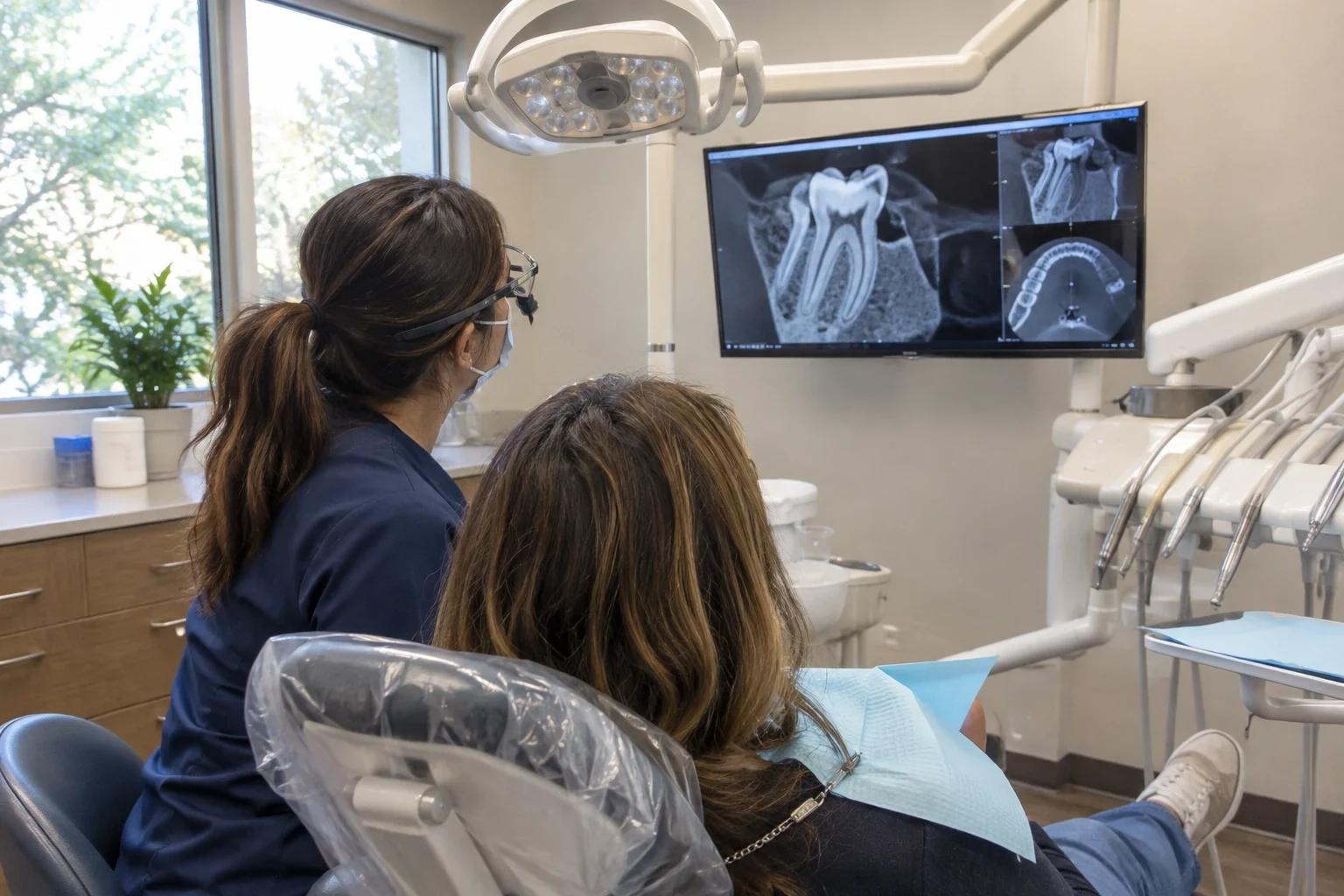
We start with a focused evaluation: a full exam, digital X-rays and a CBCT scan if the tooth needs a closer look at the roots and bone. Then we show you what we found and lay out both options in a written treatment plan, including what replacing the tooth would involve if you choose extraction.
The same person who answers your first call stays with you through scheduling, insurance questions and follow-up, so you are not repeating your story at every step. If you choose to save the tooth, we handle the root canal and crown. If you choose extraction, we plan the replacement with you, whether that is an implant, a bridge or a denture.
More questions about pulling a tooth versus saving it
- Is a root canal more painful than an extraction?
- With modern local anesthetic, most patients find a root canal feels much like having a filling placed. Extraction sites are often a little sore for a few days while the socket heals, so the comfort difference is smaller than many people expect.
- Can I get a dental implant right after an extraction?
- Sometimes, if the bone is healthy and the infection is under control. Other times we let the area heal first or place a bone graft, and the CBCT scan helps us decide which approach fits your tooth.
- Should I wait and see if the pain goes away?
- Pain that fades does not always mean the problem is gone, because an infected nerve can die and stop hurting while the infection continues. Having it checked early keeps more options open, including saving the tooth.
- Does it matter if the tooth is in the front or the back?
- Yes. A front tooth affects your smile right away, so most patients want it replaced quickly. A back tooth carries more chewing force, which is why it usually needs a crown after a root canal or a sturdy replacement after extraction.

Find out whether your tooth can be saved
Your call books a focused evaluation with an exam, digital X-rays and a CBCT scan if needed. You leave with both options explained and one person to coordinate whatever you choose.